
Modern junior tennis training is increasingly dominated by stroke production—the biomechanics of hitting a forehand, backhand or serve in isolation. While technical skill is undeniably vital, it raises a fundamental question:
Are we teaching juniors how to play tennis? Or just how to hit tennis balls?
Tennis isn’t just Shot Production – It’s Shot Sequencing
Playing tennis involves problem solving. It means having tactical sequences in your armoury—patterns of play that link one shot to the next to create point-winning opportunities. Knowing when to use these sequences is just as important as knowing how to execute them.
In 135’s consulting work with junior players, we always ask one simple question: “The score is 4-all, 30-all. What are you going to do?”
After some thought, most junior players answer with: “I’ll serve to [insert location here].”
Our immediate response is always the same: “…and then?”
This “and then?” exposes a problem in junior player development: young players are trained to hit balls in isolation, but are they trained to think about the sequence that is likely beyond that one shot? Are they thinking like a Chess player ie two or more moves ahead, or are they just playing the immediate next move/ball in front of them?
Adding Shot Sequencing to Training
The solution is not to remove technical training. Far from it. It’s the foundation from which shot sequence training evolves. Modern tennis is too fast to ignore fundamental technical training. However, training shot sequences in tandem at a young age helps players understand:
- Cause and effect – if I serve here, the likely response will be here.
- Playing in context – who is my opponent and what strategies do I have to beat them.
- Score-based decision making – more context while adding the risk/reward of the score.
- What are the conditions – court surface, weather and other factors.
Even at the junior level, players should begin training sequences, not just strokes. If a player knows what they want to achieve on Shot 3, they automatically build purpose into Shot 1.
A real world example
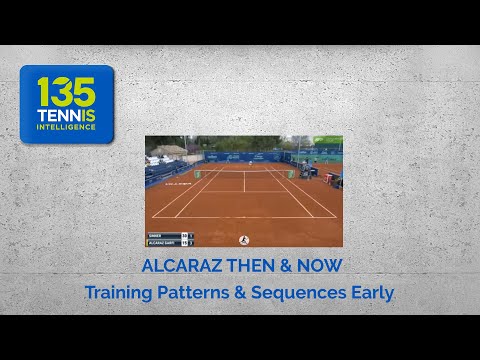
Watch videoA Real World Example – Alcaraz and Sinner
To demonstrate the power of training shot sequencing at an early age, we analysed the 2025 French Open men’s final between Carlos Alcaraz and Jannik Sinner and compared it to the data of a match they played in 2019, when they were just 15 and 17.
The wider statistical findings are for another day. For this article, we produced the following short video. Grainy and without sound it may be, but the shot sequencing of Carlos Alcaraz is clear:
Wide serve to Ad, Inside In Forehand to the open court – six years apart
This tells us something profound: he didn’t start training shot sequences and patterns at 15. That kind of tactical awareness traces back to the 12s.
Not everyone is Carlos Alcaraz — but the lesson is universal: players who rise beyond the junior levels are not just hitting balls — they training shot sequences.
135 – “Profile, Benchmark, Measure”
Tennis has long measured players by unforced errors, winners and by the final score. But these metrics are incomplete and often misleading. They don’t show how points were constructed. They don’t reveal decision-making.
135 is the only system that profiles a player using metrics that make sense; benchmarks players against world’s best at the same stage; and measures improvement over time.
Academics, fitness, leg speed. These things can all be measured. Now we can measure matchplay as well……and not just using the score.